December 2023 – Work continues on the house at Pemberton. The brickies are on time and the work looks good as they head toward completion of the brick laying before Christmas.
In the background you can see the greenhouse, potting shed and the area that will become the vegetable garden.
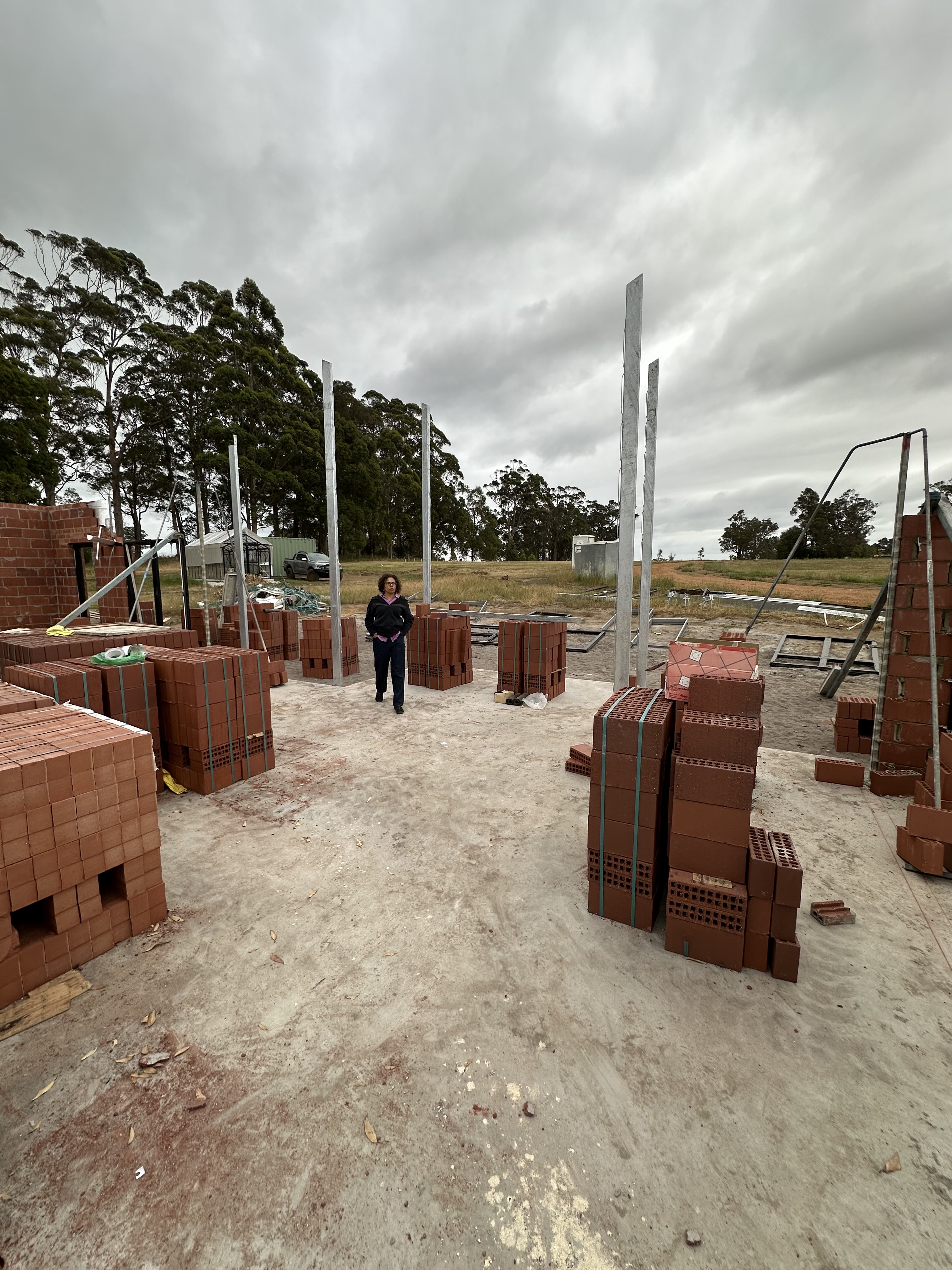
In this view Melissa walks from the entry foyer into the grand living room towards the kitchen.

This is the view towards the front of the house. The walls and widows to Master Bedroom area can be seen on the left of the picture.
Discussions with local contractors to assist with the landscaping have commenced. This includes construction of paths, steps, retaining walls, arbours and parking areas.
The PhD is now done.
The PhD is now done. What a journey. Growing up I never thought of becoming a doctor. My dream was to carry a briefcase and have an office in the city. There were few blacks with briefcases, respected, working in offices, leading teams and progressing business visions when I was growing up. I don’t recall meeting any black businessmen, but I knew they were around, but rare. Black doctors? Even rarer. I can’t remember meeting any black doctors or seeing any… except when Dr Huxtable (in The Bill Cosby Show) made his weekly appearance.
The PhD journey was difficult, no one in the family or community had a PhD. Few went to university. Those that did got in through athletics. An early transformation for me – was changing from a quasi thug to a journey towards the desired state I wanted. In this desired state money was made through legal means, the risk of run-ins with police reduced. Along this journey I lost people that were once close to me but their journey was different and I wished them well. I met new friends over time, but never forgot where I came from. My past inspired me. Drove me.
I did get my briefcase. I had an office. Led teams. Presented at conferences. Became an inventor. Now the PhD is done. I am happy, thankful and feeling good and fortunate. A new post-PhD journey starts. In terms of my journey, the PhD can be considered my current state. My new desired state is still a bit ambiguous, but it involves love, happiness, continuing to learn and sharing my knowledge and experience.
Some information about the PhD follows. If you would like more information about the PhD or would like to get a copy of the thesis, please contact me at: amwtransforms@gmail.com.
PhD title
Considerations for Reducing Risk of Community Engagement and Associated Knowledge Management Sociotechnical Initiatives
PhD abstract
The rapid development of digital technologies over the past three decades has resulted in a significant investment in technologies and associated infrastructure. This development has transformed how public, private, and not-for-profit organisations engage with stakeholders. One area of transformation involves opportunities to enhance the means and frequency with which community organisations are able to engage with residents and to collect and manage knowledge from these interactions. Despite this, there is a high rate of failure of such sociotechnical initiatives.
My attention and interest were drawn to determining how community organisations in Western Australia (WA) engage with residents and capture knowledge from these interactions through digital technologies. To understand the extent to which community organisations are undertaking such activities, this study sought to increase understanding of the contextual factors that may help mitigate risk associated with the use of sociotechnical solutions for engaging and capturing knowledge from interactions with residents.
Academic and professional literature identifies multiple actors and networks involved in transforming processes and services through the use of digital technologies. Consistent themes from the literature include the pervasive nature of digital technologies and the high failure rate of sociotechnical initiatives. Some research indicates the high failure rate may be attributed to current influential models or frameworks’ not adequately capturing the iterative nature of transformation, not sufficiently considering the culture of stakeholders, and not appropriately understanding power dynamics between actors and networks.
This longitudinal study explores how a sample of five community organisations based in metropolitan and regional WA make use of digital technologies to engage with residents. The first wave of interviews for this study commenced in 2006. The second and final wave of interviews commenced in 2016 and concluded in 2018.1
To better understand the relationships and dynamics between multiple and diverse actors and networks, Actor-Network Theory (ANT) is employed. ANT is both a theory and a method for describing and explaining the interaction between the social and the technical.
ANT allows the examination of hierarchy and power and processes within and between actors and networks to be investigated. The transformation model proposed in the thesis synthesises existing sociotechnical models and frameworks and considers complex social and technical challenges. The model embeds activities to influence and change culture, incorporates the role of power, and reduces risk to transformation through use of digital technologies that might arise from sociotechnical initiatives. The proposed model focuses on the interaction and influence between the themes of leadership and management; culture; process; and technology to mitigate risk that may hinder successful transformation.
1 The reason for the time between the first and second waves of interviews is that I put my PhD in hiatus. The hiatus also provided the opportunity to conduct a longitudinal study to examine whether time had made any difference to how organisations approached community engagement and knowledge management.
 Being Arthur