There is a particular kind of confusion that settles deep in an institution when it genuinely does not know what to do. You can feel it in Western Australia’s universities right now. You can feel it across much of the sector nationally, and I suspect internationally too. It is not the confusion of complacency. It is the uncertainty of institutions know the ground shifting beneath them, and that their peers are in a similar situation, and see the same confusion reflected back.
It is worth getting this diagnosis right, because a wrong diagnosis leads to wrong prescriptions. The problem is not that senior leaders have decided to wait and see. It is that the game has changed so fundamentally, and at a constant rate, that many have not fully registered the depth of the change and the agility needed for relevance. There is no obvious model to follow. I am not sure that an institution has solved this yet, or has even confidently framed the problem. There is no standard to replace a now obsolete model. So institutions chip away in the traditional manner: a policy here, a pilot there, a working group somewhere, without any coherent picture of what a university in an AI world is actually for and what it would look like.
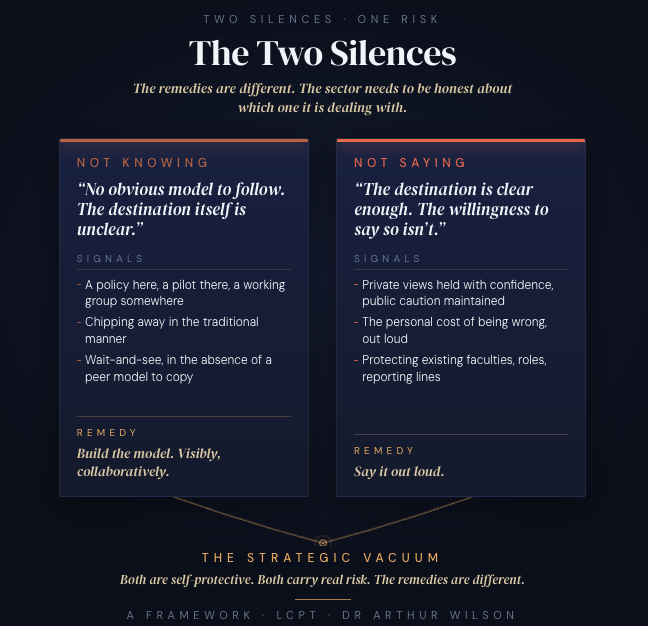
But there is a second, less comfortable possibility, and it deserves equal weight. In broad terms, most senior leaders in the sector already know that AI has the potential to be a major disruptor across leadership, culture, process, and technology: the very networks this piece returns to. This may mean fewer, and differently skilled, staff. It may mean a different relationship between teaching, assessment, and the tools students use. It means a research enterprise reshaped by what AI can now do faster than a postdoc. What is missing is not the knowledge, it is the willingness to say it out loud. Naming this direction has strategic and operational implications across the whole organisation, and that is uncomfortable to articulate while still presiding over the existing structures in question. Being wrong, in public, about risks and opportunities this consequential carries a personal cost that staying vague does not. Both forms of silence, genuine uncertainty about the destination, and knowing roughly where things are headed but not wanting to be the one who says so, are, in the end a significant risk and self-protective. The sector needs to be honest about which one it is dealing with, because the remedies are different.
We have been here before, though perhaps not quite in the way the comparison is usually made. In the mid-1990s, leaders and managers debated whether their organisation needed a website, and whether email was a serious communication tool or a novelty. The conventional story is that those leaders simply couldn’t see what was coming, so they can’t be blamed for failing to take action. But look closer and a different pattern emerges. By the mid-1990s, plenty of people inside those organisations, often junior, often in IT or marketing, could see exactly where things were heading, and said so. What stalled the response wasn’t always a failure of leadership foresight. It was that acting on that foresight meant dismantling, or significantly changing, existing structures and the career paths that many had spent decades building. Naming the direction clearly would have meant admitting that large parts of the existing organisation, and the skills needed to operate it, were about to face significant uncertainty and complex change. The institutions that delayed were not blind. They were protecting something. AI is, if anything, harder to plead ignorance about: it did not arrive quietly in a research lab but in every student’s browser overnight, and university leaders use it themselves, daily. The “we couldn’t have known” defence, already thin in the 1990s, is simply not available this time.

The AI revolution is a larger discontinuity than the arrival of the web, and universities. The institutions society nominally trusts to think furthest ahead are, on the whole, not ready for it. Not because the technology is too hard, and not because the people running these institutions are complacent. Because the leadership, the culture, the processes, and the technology strategy inside our universities are not yet aligned to the scale of what is changing around them, and because no one has yet shown them what aligned looks like.
It is obvious this is not a technology problem
The first thing to say clearly is that this is not, at root, a technology problem. AI are already embedded in how students write, how researchers draft, how administrators summarise, and how professional staff prepare briefs. That horse has left the stable; it is three paddocks away and accelerating. The question is no longer whether AI will reshape higher education. It already has. The question is how universities will evolve and who will lead that reshaping. It is also worth asking: What will happen to the universities that accommodate the transformation grudgingly, or those being reshaped against their will.
In our research on transformation projects, we argue that sociotechnical change plays out across four interacting networks: leadership and management, culture, process, and technology. The first two are strategic. The second two are operational. Transformation fails reliably, predictably, and expensively when these four are out of step with one another. Looking at the Australian university sector through that lens, the alignment these networks require some work.If you are a senior leader reading this, the following sections are not really about “the sector.” They are about your institution, and possibly about you. The failure to name and weigh the risks of acting and not acting, the mixed signals staff receive about AI and its organisational impact, the slow evolution of assessment processes, and the shifting alignment between business strategy and technology, these are not abstract sector-wide patterns. They are very likely things you have seen in the last six months, possibly in a meeting you chaired. The uncomfortable question this piece is really asking is not “is the sector ready?” It is: what, specifically, have I not yet been willing to say out loud, and why?
Strategic drift: leadership without conviction
Start with leadership and management. A handful of vice-chancellors and senior executives have spoken publicly and courageously about AI. Most have not. What passes for an AI strategy in many institutions is a policy document about academic integrity, a cautious statement about staff use, and a working group whose terms of reference are narrower than the problem they are trying to address. That is not a strategy. It is a risk posture.
An adequate strategy would answer hard questions. What does a degree from this university mean in a world where a capable student, supported by AI, can produce work that would have earned a distinction ten years ago? What does research supervision look like when a PhD candidate’s first conversation partner is a model, not their supervisor? What do we teach, and how do we assess, when the cognitive tasks we have historically tested are the ones most rapidly being automated? What is the university “for”, now.
The absence of confident, ambitious answers to those questions is the strategic vacuum at the centre of the sector. Leadership is not only about governance and compliance. It is about direction, and direction requires a view of the future that is bolder than the present. Setting that direction in the absence of a peer model to copy from is one of the hardest tasks leadership can be asked to perform. It is also, the work that must be done. Much of this hesitation, though, is not a failure of vision. Many leaders have a fairly clear private view of where this is going. What they lack is confidence that naming it publicly, and being associated with a view that might later look wrong, or that threatens existing faculties, roles, and reporting lines is worth the risk to them personally. That calculation is understandable. It is also precisely the calculation that needs to change.
Cultural lag: the gap between the lectern and the new world
Culture: The second strategic network, moves slower than leadership, and usually lags it. But in this case, in many institutions, culture is ahead of leadership, and pulling. Academics are experimenting, often privately. Professional staff are quietly using AI tools to draft minutes, summarise reports, and clear backlogs that nobody really wanted to admit existed. Students, inevitably, are furthest out in front.
What is missing is a change in cultural that names all of this honestly and gives people permission to embrace AI well. Instead, staff are often caught between a policy environment that signals suspicion and a daily workload that makes AI assistance almost irresistible. Students are told, sometimes in the same week, that AI use is prohibited, permitted with disclosure, encouraged as a learning tool, and required for an assessment task. The mixed signals are not a sign of nuanced thinking. They are a sign that the institution has not yet decided what it believes.
Resistance to change, of course, is not new. Every major transformation in the sector’s history, from mass production to internationalisation and digitisation, has met the same headwinds, and university leaders have developed a familiar playbook for working through them: articulate the destination, bring people along, reward early adopters, demonstrate the benefits. What makes AI different is that the destination itself is not yet clear. It is harder to ask staff to embrace a change when the institution cannot yet describe what it is changing toward. Addressing resistance in this environment requires something more than the standard toolkit. It requires leaders willing to describe a plausible future out loud, invite staff into shaping it, and be honest that the destination will be discovered collectively rather than handed down. Resistance grows in the vacuum where that conversation should be. It shrinks, though it rarely disappears, when people can see themselves in whatever is being built.
Culture change is hard, slow, and uncomfortable. It is also the difference between a workforce that meets a transformation with curiosity and one that meets it with anxiety. Scholars, administrators, and students all need to be prepared, not just for AI at the university, but for a world beyond the university in which AI literacy will be a baseline professional capability. That preparation is not happening at anything like the scale or pace required.
Operational mismatch: Processes built for a different world
Turn to the operational networks, and the picture is no more encouraging. Universities are, by design, process-heavy institutions. Curriculum approval, assessment moderation, research ethics, enrolment, credentialing, timetabling, grievance handling. The machinery is large, slow, and optimised for a world in which the substrate of academic work was stable.
That substrate is no longer stable. Assessment design built around essays and take-home assignments is being quietly undermined in real time. Curriculum review cycles measured in years cannot keep pace with disciplines being reshaped in months. Research integrity frameworks written for a pre-AI era struggle to give clear guidance on the appropriate use of models in literature review, coding, or drafting. The processes are not wrong. They are out of phase.
Fixing this does not mean throwing the machinery away. It means redesigning it with the assumption that AI is a standing participant in academic work, not an exception to be policed. That is a substantial body of work, and almost nobody in the sector has scoped it, let alone started it.
Technology without alignment
The fourth network, technology, is where the sector looks, superficially, busiest. Enterprise licences for major AI platforms are being signed. Vendor partnerships are being announced. Pilots are running. But a pilot is not a strategy, and a licence is not an alignment.
The deeper question is whether the technology choices being made at the enterprise level reflect a clear view of what students and staff actually need, or whether they reflect what vendors are selling and what peer institutions have bought. Technology alignment, in the sense used in information systems research for thirty years, means that technology decisions flow from strategy, not the other way around. In the absence of strategy, technology procurement becomes a proxy for action. It looks decisive. It is not.
The opportunity, and what it will take
None of this is cause for despair. It is cause for honesty. The interesting feature of the current moment is that the gap between what universities could be doing and what they are doing is wide, and it is still early. The institutions that move now, deliberately, ambitiously, and across all four networks at once, have an opportunity that will not be available in five years. They can redefine what higher education is for in an AI-saturated world, and in doing so, rebuild the relevance that the sector has been quietly losing for a decade.
Doing this will take courage. It will require leaders willing to make decisions under uncertainty, to say publicly what they believe the future of their institution is, and to be wrong in public when they need to be. It will require cultural work that goes beyond town halls and all-staff emails, into the daily practice of teaching, research, and administration. It will require process redesign at a scale the sector has not attempted in a generation. And it will require technology decisions that flow from all of the above, rather than substituting for them.
The irony is that AI itself can help. Used well, it can reduce the cognitive load of precisely the kinds of complex, multi-stakeholder transformation work that universities find hardest. It can help leaders model scenarios, help cultural change agents listen at scale, help process owners redesign workflows, and help technology teams align what they build to what the institution actually needs.
But none of that starts with the technology. It starts with leadership. It always does. The universities that understand this, and act on it, will be the ones that define the next chapter of higher education. The ones that do not will spend the next decade explaining to their councils, their staff, their students, and eventually their regulators why they waited.
We have seen this film before. It would be a shame, and an avoidable one, to sit through it again.
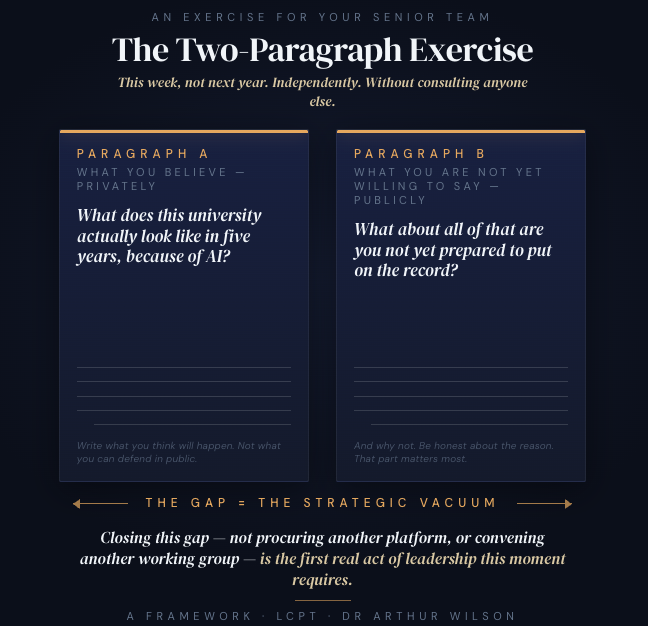
Some institutions may already have started the tough internal discussions, and advanced the actions that follow from them. If not, here is a place to start: this week, not next year. Get your senior team in a room (vice-chancellor, deputy vice-chancellors, and the heads of the areas most exposed) and ask each person to write, independently and without consulting anyone else, two paragraphs: what they believe this university will look like in five years because of AI, and what they personally are not yet willing to say about that in public. Then compare notes. The gap between those two sets of paragraphs, what people believe privately and what they’re prepared to say out loud, is the actual size of the strategic vacuum at the centre of your institution. Closing that gap, not procuring another platform or convening another working group, is the first real act of leadership this moment requires.